External dimensions
| Size and type | External length | External width | External height | External footprint |
|---|---|---|---|---|
| 20′ Standard | 6.058 m | 2.438 m | 2.591 m | 14.77 m² |
| 20′ High Cube | 6.058 m | 2.438 m | 2.896 m | 14.77 m² |
These external dimensions are for reference. Check the container's measurements before buying. The external footprint is length × width, without the space needed to open the doors or manoeuvre. This calculation does not give the storage space inside.
Use outside dimensions to plan the site, internal dimensions to arrange storage and the door opening to check loading. The standard dry reference below is about 6.06m long outside; other 20ft configurations differ.
External, internal and door dimensions
The reference occupies about 14.8m² outside, compared with about 13.9m² of internal floor. Door movement, loading and delivery need space beyond that footprint. Use the table for the three separate sets of measurements.
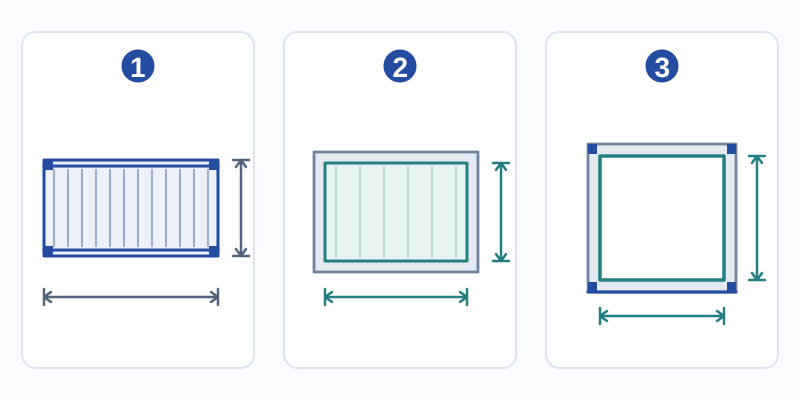
Visual reference
- External dimensions
- Internal space
- Door clearance
Illustrative diagram, not to scale.
| Measurement | Example measurements | What they're for |
|---|---|---|
| Typical exterior dimensions | About 6.06 × 2.44 × 2.59 m (20 ft × 8 ft × 8 ft 6 in) | Placing it on your property |
| Interior dimensions of the example | 5.900 × 2.352 × 2.395 m (about 19 ft 4 in × 7 ft 8½ in × 7 ft 10 in) | Storage plan |
| Door of this example | 2.340 m wide × 2.292 m high (about 7 ft 8 in × 7 ft 6 in) | Check the passage of objects and equipment for loading |
| Calculated internal floor area | About 13.9 m² | Interior length × interior width |
| Interior volume stated for this example | 33.2 m³ (about 1,172 cu ft) | Volume before allowing space for the storage layout and aisles |
Measure the bulkiest object and the door opening
Measure the item with its packaging, pallet, handles or wheels. Include the equipment and room needed to move it through the opening.
If it must stay upright, say so. Do not assume it can be tilted; for heavy machinery, have floor suitability and handling assessed separately from the opening size.
Draw a storage plan, even for a small stock
Draw shelves and goods using the confirmed internal measurements. Keep frequently used items near the entrance and allow room to open bins, handle stock and retrieve equipment after the store is full.
Why 33.2 m³ doesn't mean 33.2 m³ of goods
The 33.2m³ reference is empty geometric volume. Packaging, gaps, shelving and aisles reduce what fits. Use package volume to compare formats, then check rows, stacking and retrieval on a layout. Check weight and concentrated floor loads separately.
Do you need more height or different doors?
Compare High Cube if height is the constraint, Double Door for access at both ends or side-opening for access along the length. Use the matching clear openings, not the nominal size. Have structural changes assessed before planning to cut a wall.
Check the space around the container and truck access
Mark the final position, open doors and working area on a site sketch. Send the carrier measured entrance, bend and overhead clearances, ground details, supports and available unloading equipment. The carrier confirms the vehicle and method for that route.
Measurements to prepare before buying a 20-foot
- Largest item measured in its loading arrangement.
- Actual internal dimensions and clear door opening.
- Shelves, aisles and retrieval shown on a plan.
- Weights and handling equipment checked separately.
- Container position, open doors and delivery route marked.
See matching models
Containers to compare
Example models with guide prices before VAT, delivery and unloading. Images are illustrations; ask for photos of the container offered.
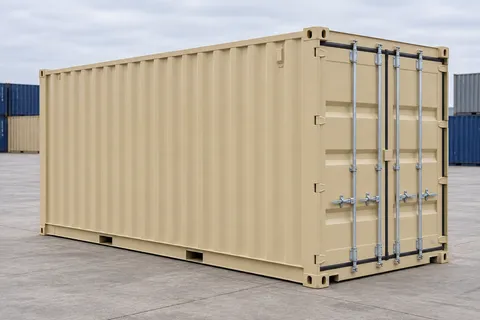
CA-20-STANDARD-NEW-BEIGE
20ft Standard container · New · one trip · Beige
New · one trip / Beige
£1,390 Indicative, excl. VAT
Request a quote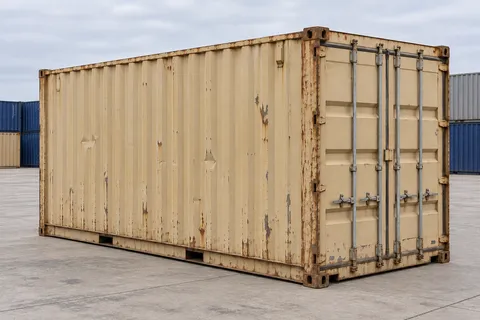
CA-20-STANDARD-C-BEIGE
20ft Standard container · Used · last trip · Beige
Used · last trip / Beige
£550 Indicative, excl. VAT
Request a quote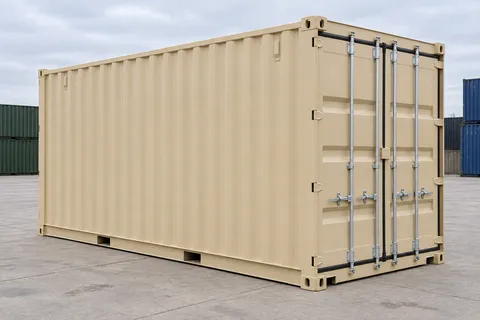
CA-20-HIGH-CUBE-NEW-BEIGE
20ft High Cube container · New · one trip · Beige
New · one trip / Beige
£1,810 Indicative, excl. VAT
Request a quote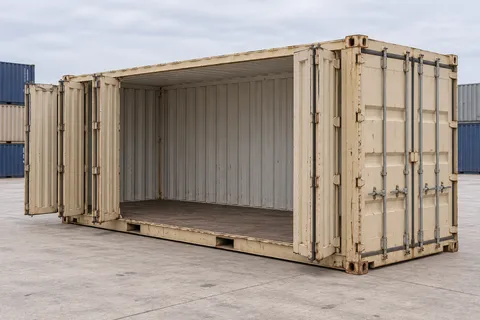
CA-20-OPEN-SIDE-B-BEIGE
20ft Open Side container · Used · good condition · Beige
Used · good condition / Beige
£1,790 Indicative, excl. VAT
Request a quote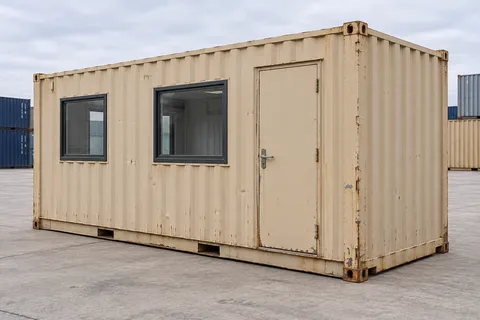
CA-20-OFFICE-B-BEIGE
20ft Office container · Used · good condition · Beige
Used · good condition / Beige
£4,370 Indicative, excl. VAT
Request a quote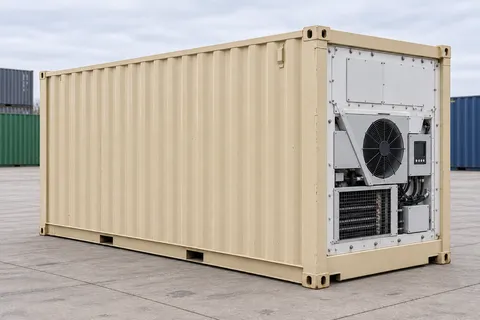
CA-20-REEFER-A-BEIGE
20ft Refrigerated container · Used · excellent condition · Beige
Used · excellent condition / Beige
£4,650 Indicative, excl. VAT
Request a quoteFrequently asked questions
Are the dimensions of a 20-foot reefer identical to those of the standard?
No. The outside is the same, but insulation and the refrigeration unit make the inside smaller: about 5.46 × 2.29 × 2.28 m (28.4 m³) on our reference 20ft reefer. Ask for the interior measurements and door opening of the reefer you're considering.