Check the actual unit’s empty weight, contents and documented limits before arranging a move. The standard-model figures below explain the calculation; they are not the weights of every 20ft container.
Documented example · 20-foot standard
| Tare · empty weight | 2,350 kg |
|---|---|
| Maximum payload | 28,130 kg |
| Maximum gross mass | 30,480 kg |
Example from a transport company’s fleet. Values vary by manufacturer and do not establish availability. Check the offered container’s markings and documents.
Calculate the mass to move
Example: 2,350 kg empty container + 10,000 kg contents = 12,350 kg total. The sum does not establish that your container can be loaded or lifted this way.
Distinguishing empty weight, payload, and gross mass
Tare is empty weight. Payload is the allowed contents weight. Maximum gross mass is the limit for both together: payload = maximum gross mass − tare.
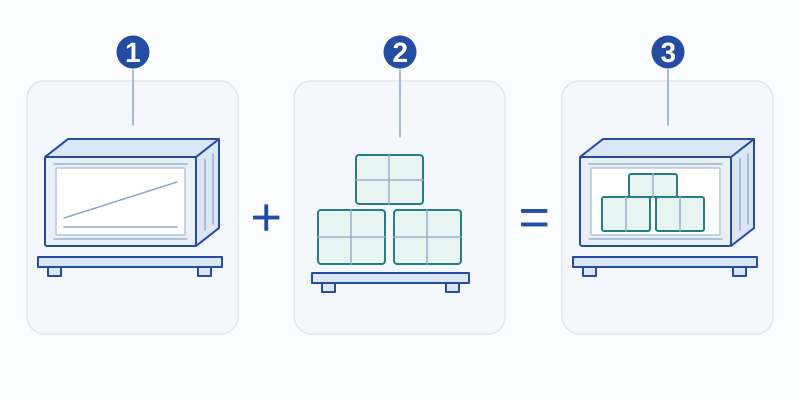
Visual reference
- Empty container
- Contents mass
- Total gross mass
Illustrative diagram, not to scale.
The standard example has a 2,350kg tare, 30,480kg maximum gross mass and 28,130kg maximum payload. Use one model’s matched values, then check the actual unit, floor, load distribution and movement limits.
| Situation | Information needed | Don't confuse with |
|---|---|---|
| Buying an empty container | Empty weight with the equipment actually fitted | An average found for the same size |
| Moving the loaded container | Confirmed empty weight and the full weight of everything inside | The maximum payload by itself |
| Storing a heavy load | Weight of contents, support points, and distribution on the floor | A total limit that would allow everything to be placed on a single point |
| Comparing a modified container | Data and documentation after modification | The original data sheet before conversion |
Check that the markings match the container being offered
Match the unit number with clear weight markings, documents and the offer. Ask which fittings, repairs or modifications the stated tare includes. Have the actual weight established if current equipment is not covered by the documents.
Count all contents, including pallets and packaging
List everything remaining inside during the move, including goods, packaging, pallets and equipment not already included in the confirmed tare. State what is added or removed before the operation.
Give transport and handling providers the resulting weight and load plan. Weight alone does not establish that their vehicle, equipment or supports suit the move.
Also check the concentrated weight under each support
For a machine, give weight, dimensions, contact-point sizes, position and loading method. Have concentrated floor loads assessed for that container. Dividing weight by the footprint does not establish a rating beneath each foot or wheel, or approve forklift entry.
Have the transport and lifting checked against the actual weight
State whether the move is empty or loaded. Send actual weight, load layout, address, access and final position. The carrier checks the vehicle and route; the handling provider checks its equipment and working arrangement. Include any later shipping requirements separately.
- Container condition at departure: empty, equipped, or loaded.
- Total weight, noting any components whose weight is still unknown.
- Plan of the contents and details of concentrated loads.
- Access, obstacles, machine position, and final location need to be checked.
Ask for the data sheet of the model and equipment being delivered
Standard, High Cube, refrigerated, office and special-opening models have different construction and equipment. Use current documents for the offered version. For a conversion, account for work completed and anything added after delivery.
Choose a size that suits the load and available space
Compare dimensions and weight together: compact heavy goods and bulky light goods reach different limits. When comparing with a 40ft, use its own matched data; roughly twice the volume does not mean twice the payload.
Information to send to the professionals
- Unit identity, current markings and documents matched.
- Tare confirmed with fitted equipment accounted for once.
- Goods, pallets and packaging weighed for the planned move.
- Heavy contact points and load layout supplied.
- Empty or loaded operation, route and final position identified.
- Container, floor, transport and handling limits assessed separately.
Technical reference for this example
- Hapag-Lloyd — 20ft standard fleet example
The same fleet example supplies the 2,350kg tare, 30,480kg maximum gross mass and 28,130kg maximum payload. These are not the markings or condition of a supplier’s actual unit.