A 40ft offers more length, not automatically twice the payload of a 20ft. Establish the actual unit’s weight and contents before planning transport or lifting.
Documented example · 40-foot standard
| Tare · empty weight | 3,750 kg |
|---|---|
| Maximum payload | 28,750 kg |
| Maximum gross mass | 32,500 kg |
Example from a transport company’s fleet. Values vary by manufacturer and do not establish availability. Check the offered container’s markings and documents.
Calculate the mass to move
Example: 3,750 kg empty container + 10,000 kg contents = 13,750 kg total. The sum does not establish that your container can be loaded or lifted this way.
Distinguishing empty weight, contents, and total limit
Tare is empty weight; payload is the allowed contents weight; maximum gross mass is the combined limit. Payload = maximum gross mass − tare.
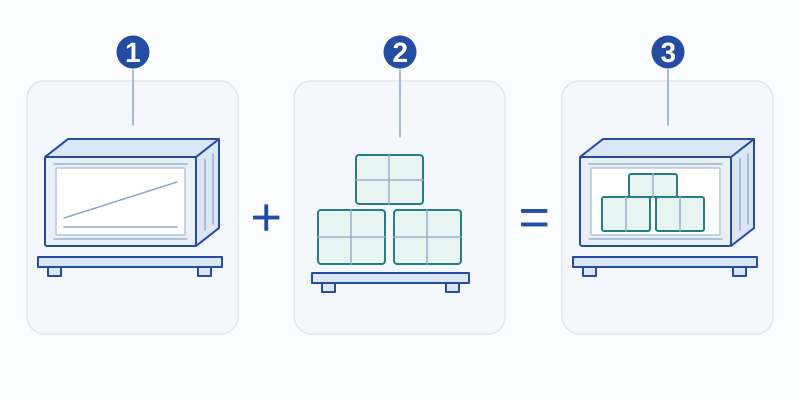
Visual reference
- Empty container
- Contents mass
- Total gross mass
Illustrative diagram, not to scale.
The standard example has a 3,750kg tare, 32,500kg maximum gross mass and 28,750kg maximum payload. Those values belong together and do not establish the limits of another unit.
Why a 40-foot container doesn't carry twice the weight of a 20-foot container
In the two standard examples, volume rises from 33.2m³ to 67.7m³, while payload rises from 28,130kg to 28,750kg. That is more space with only a small change in the stated load limit.
Check what limits the actual stock first: dimensions, total weight, concentrated floor loads or the proposed movement. Spare space does not establish spare carrying capacity.
| Your stock | Priority question | Additional check |
|---|---|---|
| Furniture or bulky items | Does everything fit with packaging? | Door clearance and access to items at the back |
| Heavy distributed loads | What will be the total weight of the stored items? | Distribution, floor, and movement limits |
| Machine on a few supports | What weight does each area of the floor carry? | Support points, loading method, and an assessment of the loads on the floor |
| Evolving stock | What will be the most heavily loaded situation? | Organization, inventory, and updating of masses |
Calculate what will actually be moved
Inventory goods, packaging, pallets, shelving and equipment that will remain during the move. Add only items not already included in the confirmed tare.
State the operating stage: empty delivery, fitted-unit relocation or collection after loading. Update the providers if goods or fittings change; an empty-move plan does not cover a later loaded operation.
Spread the weight along the length of the container
Draw each heavy item with weight, position and contact-point sizes. Have floor loads, distribution and securing checked for the operation. Dividing maximum gross mass by floor area does not give an allowable load beneath each machine foot or wheel.
- Draw the position of loads, not just their order of arrival.
- Identify machines, narrow supports, and concentrated loads.
- Specify how the goods will be loaded and which equipment you plan to use.
- Have the supports that will distribute the load checked for this container and this use.
Use the data for the standard, High Cube, or equipped model you've chosen
Use the current standard, High Cube, reefer or special-opening unit’s own data. For an office or conversion, obtain documents for the delivered fit-out and declare later additions rather than relying on the original shell specification.
Preparing transport, access, and placement of the 40-foot container
Send the carrier the measured approach, entrance, turns, obstacles, unloading area, final position and door orientation. Give the handling provider the actual weight and load plan.
Have ground, supports, equipment and working conditions assessed for the same operation. The container’s own limit does not establish the limits of the vehicle, route or lift.
Comparing a 40-foot container with several shorter containers
When considering two smaller units, allocate the goods to each and check each load and location. Compare delivery and handling arrangements for the same stock, keeping each model’s weight figures separate.
Information for preparing transport or delivery
- Actual model, unit number and documents matched.
- Current tare includes the agreed fitted equipment.
- Contents inventory matches the time of the move.
- Heavy loads and contact points shown on a plan.
- Approach, unloading area and final position documented.
- Transport, handling and ground assessed for that operation.
Technical reference for this example
- Hapag-Lloyd — 40ft standard fleet example
The same fleet example supplies the 3,750kg tare, 32,500kg maximum gross mass and 28,750kg maximum payload. Confirm the actual unit and operation separately.