Start with the largest item you’ll store and the one you’ll take out most often. Those two items tell you more about the container you need than the total number of boxes in your garage or warehouse.
Start with how you will use it
Write down whether this is for occasional storage, daily stock picking, an office or cold storage. For daily tools, doors that open easily may matter more than a clean paint job. For a customer-facing spot, decide how much appearance matters before you compare grades.
Choose 10ft, 20ft or 40ft around the floor plan
A 10ft makes sense for a few bulky things you want out of the garage. A 20ft can take a longer run of shelving or mixed equipment. A 40ft works when you need a continuous long space or have a way to keep the back accessible. Sketch the aisle before paying for more length.
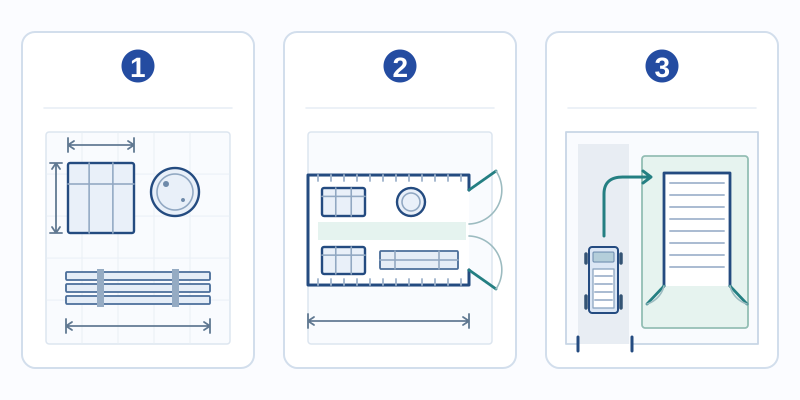
Visual reference
- Inventory
- Size and configuration
- Site and placement
Illustrative diagram, not to scale.
Match the opening to the way things move
Standard cargo doors work well when you can load from one end. For stock used from opposite sides of a yard, compare doors at both ends. If you regularly pull one pallet from the middle of a row, check a side-opening model and the space its panels need.
Choose a condition you can use on delivery day
If you want to use the unit immediately, ask what the seller covers for door operation, floor condition and water entry. If you can accept repairs, list them and price them first. With one-trip units, agree how much handling wear you’ll accept.
Ask for the fitted office or reefer specification
For an office, use the finished floor plan and the equipment list. For a reefer, provide incoming and target temperatures in °F and confirm the power requirement for the actual machine. Shell dimensions help with placement. Finished dimensions and the equipment determine how it works.
Check the truck route before comparing final prices
Show the carrier the gate, driveway turns and drop spot. Send the street address and ZIP code and ask who unloads and positions the unit. Compare quotes that describe the same placement job.
Put your decision in the written offer
Once you have a model, ask when the seller can identify the actual unit. Keep the quote, recent photos, accepted condition and delivery plan together so you can check the same details when it arrives.
A shortlist you can send to a seller
- Use and dimensions of the largest item.
- Door layout, condition and any required equipment.
- ZIP code, access photos and desired delivery position.
Find the right type of container
Practical questions
What is a good first size for storing tools?
Sketch the equipment, shelves and aisle at 10ft and 20ft first. If you can pull out the largest item without shifting a row of boxes, the smaller unit may be enough.
What if both sizes fit but the driveway is tight?
Send the carrier the exact approach for each size. Gate width alone is only one part of access. Ask what its truck needs at the tightest turn and while unloading.
Technical references
- Boxhub shipping container product guide
US examples of sizes, conditions and delivery methods.
- Boxhub specialty container guide
Door configurations and common reasons to choose them.